
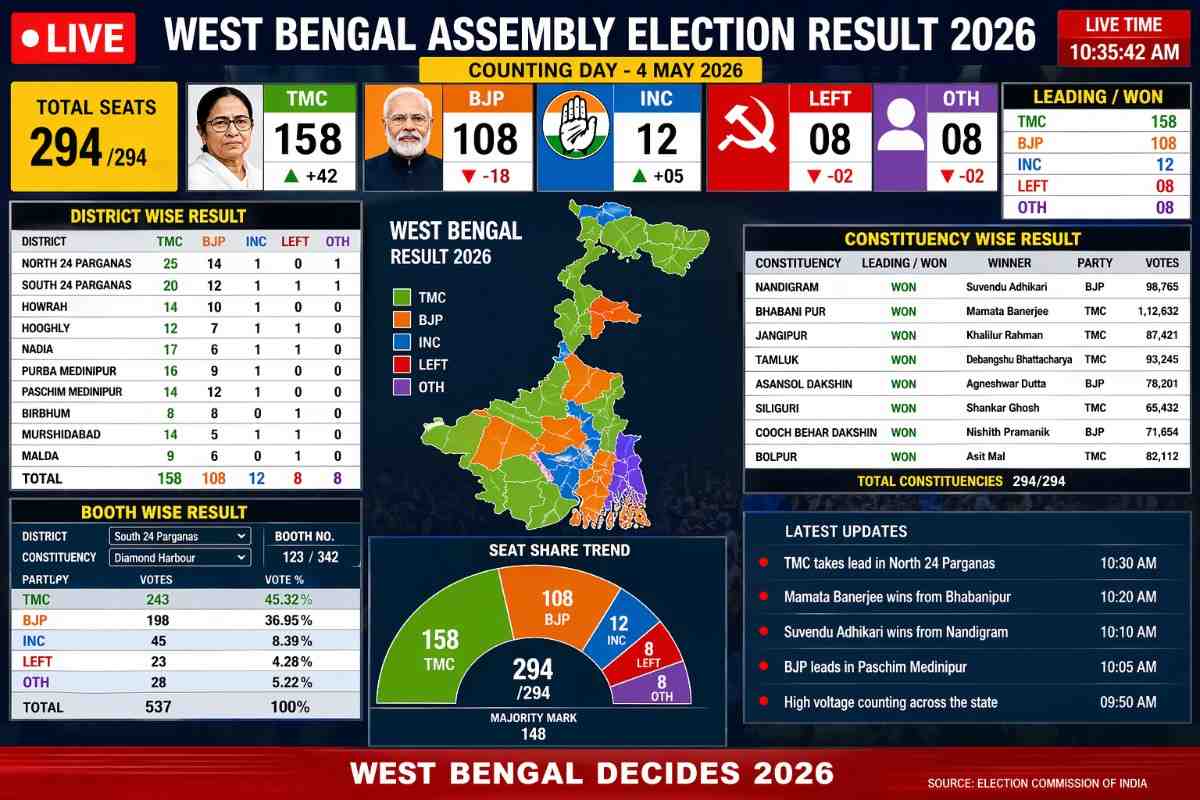
West Bengal Assembly Election Result 2026 Live,District wise,booth wise Result
WB Assembly Election Result 2026:The West Bengal Assembly Election 2026 stands as one of the most closely watched and politically significant state elections in India. With 294 seats at stake and a majority mark of 148, the contest has largely revolved around two प्रमुख शक्तियाँ—Mamata Banerjee-led All India Trinamool Congress (TMC) and the Bharatiya Janata Party (BJP) led in the state by Suvendu Adhikari.
Although the official results are scheduled to be declared on 4 May 2026, the election process itself has already revealed key trends, voter behavior, and political narratives that are likely to shape the final outcome.
West Bengal Assembly Election Result 2026
The 2026 Assembly elections were conducted in two phases—April 23 and April 29, covering all constituencies across the state.A total of 2,926 candidates contested these elections, reflecting a highly competitive political environment.The West Bengal Assembly Election 2026 represents a crucial moment in the state’s political journey. With record voter turnout, intense campaigning, and a sharp contest between TMC and BJP, the election reflects both continuity and change in Bengal’s democratic landscape.
While Mamata Banerjee seeks to retain power and extend her long-standing rule, the BJP is pushing hard for a breakthrough that could redefine the state’s political dynamics.
Ultimately, the people of West Bengal have delivered their verdict through unprecedented participation. Now, all eyes are on May 4, 2026, when the final results will reveal whether the state chooses stability or a new political direction.
The election is crucial because it determines whether:
- Mamata Banerjee secures another term (continuing TMC’s dominance since 2011), or
- BJP achieves a historic breakthrough in the state.
Record-Breaking Voter Turnout
One of the most striking features of the 2026 elections has been the exceptionally high voter turnout, which crossed 90% in several phases, making it one of the highest in the state’s electoral history.
In fact, reports suggest that turnout levels have been the highest since the end of Left Front rule in 2011, indicating massive public participation.
Such high engagement signals:
- Strong democratic awareness
- Increased political polarization
- A highly motivated electorate eager for either continuity or change
Political Background
In the 2021 Assembly elections, the TMC achieved a landslide victory:
- TMC: 215 seats
- BJP: 77 seats
- Others: negligible presence
Since then, BJP has steadily expanded its base, especially in:
- North Bengal
- Urban and semi-urban constituencies
Meanwhile, TMC has relied on:
- Welfare schemes
- Strong grassroots organization
- Minority vote consolidation
District-Wise Voting Trends (Phase 1 Insights)
Although final results are pending, district-wise turnout data gives key clues about political momentum.
North Bengal Districts
1. Cooch Behar – 95.17%
One of the highest turnout districts, indicating strong voter mobilization. Traditionally a battleground between TMC and BJP.
2. Alipurduar – 91.42%
High turnout suggests active tribal and rural participation, which may influence close contests.
3. Jalpaiguri – 94.09%
A politically sensitive district where both BJP and TMC have strong presence.
4. Darjeeling – 88.48%
Slightly lower turnout compared to other districts, but still significant. Regional issues and Gorkha politics play a role.
5. Kalimpong – 82.99%
Among the lowest turnout districts in Phase 1, possibly impacting overall margins.
North & Central Bengal
6. Uttar Dinajpur – 93.33%
High turnout indicates strong engagement in minority-dominated areas.
7. Dakshin Dinajpur – 95.22%
One of the highest polling districts, suggesting intense competition.
8. Malda – 93.41%
Historically a Congress stronghold, now witnessing triangular contests.
9. Murshidabad – 93.32%
Another minority-heavy district with high turnout, crucial for TMC.
Western & Junglemahal Region
10. Jhargram – 92.04%
A key tribal belt where BJP has made inroads in recent years.
11. Purulia – 90.28%
Known for BJP growth since 2019; turnout suggests continued political interest.
12. Bankura – 91.76%
Close contests expected between BJP and TMC.
Industrial & South-West Belt
13. Paschim Bardhaman – 89.82%
Urban-industrial voters may influence development-based narratives.
14. Birbhum – 94.19%
A stronghold of TMC, but high turnout indicates possible shifts.
Coastal & Southern Districts
15. Purba Medinipur – 90.64%
Politically significant due to leaders like Suvendu Adhikari.
16. Paschim Medinipur – 89.82%
A mixed political landscape with close contests expected.
Key Issues in the 2026 Election
1. Anti-Incumbency vs Welfare Politics
After over a decade in power, TMC faced some degree of anti-incumbency. However, welfare programs like:
- Lakshmir Bhandar
- Kanyashree
have helped maintain its voter base.
2. Law and Order & Allegations of Violence
Election-related violence once again became a major concern. Reports included:
- Clashes between party workers
- Attacks on candidates
- Allegations of voter intimidation
Such incidents have historically influenced voter perception in Bengal politics.
3. Electoral Integrity Concerns
There were also isolated complaints of:
- Booth rigging
- Fake voting
For instance, a first-time voter reportedly found her vote already cast in Siliguri, raising questions about transparency.
TMC vs BJP: The Central Battle
Trinamool Congress (TMC)
Led by Mamata Banerjee, TMC entered the election with:
- Strong rural support
- Welfare-driven governance model
- Organizational depth
Despite some erosion in support, it still remained a formidable force.
Bharatiya Janata Party (BJP)
BJP aimed to convert its growing vote share into seats by:
- Focusing on nationalism and development
- Targeting corruption allegations
- Mobilizing urban voters
The party’s biggest challenge remained converting popularity into constituency-level victories.
Role of Other Parties
While the main contest is bipolar, other parties also played a role:
- Left Front (CPI-M): Attempting a limited revival
- Congress: Contesting selectively
- Regional players and independents: Influencing local outcomes
However, their overall impact is expected to be limited in determining government formation.
Importance of the 2026 Results
The outcome of this election carries significance beyond West Bengal:
1. National Political Impact
- A BJP victory would mark a major expansion in eastern India
- A TMC win would strengthen regional parties against national dominance
2. Leadership Stakes
- Mamata Banerjee’s national ambitions
- BJP’s long-term eastern strategy
3. Policy Direction
The result will influence:
- Welfare vs development policy debates
- Investment climate in the state
- Centre-state relations
West Bengal Assembly Election Result 2026 Live District wise Result
